My Divine Appointment with Ann

Every night at the hospital is different.  Some are busy with good old-fashioned hard work.  Some nights are extremely peaceful, everyone seems to be sleeping well, and are generally doing okay.  Occasionally I will have a night where it is evident that God is doing something more overt than usual.  Now, to be fair, God is always doing things in our lives, but it is usually when we don’t expect it that memorable things occur.  I remember years ago hearing prophet Larry Randolph say something that has always stuck with me, “In the midst of the mundane, the supernatural happens.”  Often it is in the middle of the most mundane and unextraordinary things that we see God do the spectacular, the fascinating, and the life-giving.  My friend Diane calls these encounters “divine appointments”.  My night with a patient named Ann (not her actual name) was one such memorable time, and I want to share the story of that night and the various things God did during my Divine Appointment with Ann.

I was working in the float pool at the time, which is a lot like being a substitute nurse for whatever floor has a nurse call in sick, etc., and was assigned to a PCU/Telemetry floor that particular night (a lot of heart-related health problems and people not well enough to be on a normal floor but not sick enough for the ICU).  Ann was one of my patients that night.  She was in her 70’s, if I remember correctly, and she just had this really enjoyable atmosphere or aura about her.  I forget how it started, but we ended up talking a bit about our lives, which then caused us to delve into a conversation about spirituality.  She grew up in the Episcopal Church like I did, but somewhere along the line she moved into shamanism.  I am not entirely sure why she asked me, but she asked me how to overcome fear and we began to talk about God’s love.  She shared with me some different spiritual encounters she had over the years (which I always love hearing about).  We even had a moment where we just stared at each other silently.  And while that normally would be really strange to do, we both just felt this unconditional love for one another and without discussing it, we both fell silent to just be in the moment with the other.  The silence in sharing of love must have lasted for at least a minute, and may even have been longer, but it was profound.  I’m not actually sure if I have had an encounter like that before, and I know I have not since.  We didn’t need to explain it to the other and we didn’t need to even discuss what had happened because in that moment of connection and love we just knew what it was and knew the other was encountering the same thing.  It was an expression of Divine Love being shared between us on a deep level.

At one point I was going to get her some pain medication for a headache she had, and given that we were already discussing things spiritual, I offered to pray for her.  You might think I pray for all of my patients, and it might surprise you to hear that I don’t.  There are times that I pray for them or over them without their awareness, releasing healing and life to them, but it is actually fairly rare that I directly offer to a patient to pray for them.  It isn’t because I’m ashamed of my faith or because I don’t think God can help them, but in current USA work culture you have to be wise about when you put those sorts of offers out there for people, and also I am often just focused on the more physical nature of my job, so it doesn’t always come up.  I commanded her headache to leave and it did, so she didn’t need the pain medication any longer—which she was happy with because she, like I, don’t prefer to use pharmaceuticals if we don’t need to.

During one of our conversations that night, I was looking in the spirit and saw a black object sticking out of her right shoulder.  When I told her about what I saw, she told me she had actually seen it on her pillow earlier that night, but in the mental space she was in it hadn’t occurred to her to “vanquish it” (her term) like she normally would.  I removed the black object in the spirit, and as I did this I saw God clothe her with a rainbow cloak.  I didn’t honestly know what it meant, so I just shared the vision with her.  Interestingly, she then told me that every morning during her morning meditations, she would pray and release life upon our government, her family, and so on, and that each morning while she would do this, she would put on what she referred to as her “spiritual raiment”.  What I loved about that is that in many ways it sounds similar to what I would call putting on the “Armor of God” that is referenced in Ephesians 6:10-18.  And even though she didn’t follow the Episcopal church’s version of faith at that point, she was still doing something that fairly matched it anyway.

I don’t have any profound message to share about this particular encounter or a special set of takeaways, except maybe that we need to remember to enjoy the moments in life even when they feel mundane.  Because it is in the middle of those mundane moments, those times of boredom or monotony, and often when we feel the least spiritual because we aren’t praying or doing anything overtly “Godly” that He reaches into our day and causes us to encounter Him, to have moments to share His love and goodness with others, and more.  And like God did with Ann and I, maybe we’ll even just share a moment of experiencing deep and wordless love for one another and Him.  After all, like prophet Larry Randolph said, “In the midst of the mundane, the supernatural happens.”


Practical Thoughts on Raising the Dead

Charlie Kirk’s execution/assassination yesterday has many people unsettled for a range of reasons, but I don’t plan to go into any of that.  What the situation has done in one of my specific areas of focus is something that consistently happens almost any time some major news event that deals with death and dying occurs.  And that is a focus on what I refer to as “Celebrity resurrection.”  I define “Celebrity resurrection” as a focus on attempting to raise the dead specifically in the case of a high profile individual, regardless of whether that person is high-profile due to their profession, news coverage of an event, or any other cause that makes it become high-profile.  What tends to happen any time a high-profile individual passes away is that for some believers it reminds them that through Christ Jesus we can raise the dead, and they have a desire to extend that offer of life to that individual.  I both love that and am frustrated by that simultaneously.  This is a difficult subject to navigate well because there are multiple factors in play that all stand in tension with another, and all of them have their own measure of validity.  So in light of yesterday’s atrocity, keeping in mind that we, the Body of Christ, are meant to provide solutions to every problem, I want to discuss some practical thoughts on raising the dead and specifically look at the barriers that one will deal with when it comes to celebrity resurrection.

Any time we are raising the dead we will ideally look to get access to their body.  Is it possible to raise someone from the dead without that? Yes. Can God re-create a body from ashes such as in cremation or a house fire? Yes.  Can He teleport someone’s body that is washed away in a flood back to you so you can raise them?  Yes, He both can and has done so. But that doesn’t change the fact that the predominant means of raising the dead is quite simply to command life over someone’s body. I don’t say this to create some sort of mental or theological limitation, but to recognize that the vast majority of the time that is how it will occur, and as such, gaining access to the body to pray should be a goal of ours.

In most first-world countries, we like to hide our dead. There are legitimate sanitary and legal reasons for some of this, but it does create barriers and restrictions to gaining access to a body for resurrection prayer.  I had someone ask me yesterday if traveling in the spirit to pray over someone’s body is an option.  Yes, that is always an option. And for those who want to understand more about what that means or what that is, I teach on the subject at length in my book The Beginners Guide to Traveling in the Spirit, so I’m not going to cover that further here.  But while it is an option, as I said above, it’s not the primary option and gaining access to the body should still be a main goal/method that we use.

Where the issues of body-access comes into conflict with raising the dead as a whole, and especially with celebrity resurrection, is that we generally need family permission to gain access to the body.  Obtaining family permission can be difficult all on its own without even considering someone’s potential high profile status.  Most people, and even most Christians, still consider the concept of raising the dead to be extremely fringe even though it is a pivotal aspect of the Christian faith—to the point that if raising the dead doesn’t happen, Christianity has zero value as a belief system because if the dead are not raised then it would be a lie.  Fortunately, God does raise the dead, Christianity is not a lie, and raising the dead is gradually becoming more mainstream as people get a greater revelation of God’s desire for abundant life for us.

Obtaining family permission is generally as straightforward as asking the family for permission.  But straightforward does not mean easy. I don’t know that there is almost ever a time when asking someone for permission to pray over their deceased loved one is not daunting.  Our own fears and doubts start to rear their heads and we have to militantly govern over our thoughts in those moments. Broaching this subject with someone has very real risks from being the target of ridicule and anger up to and including a complete loss of relationship with both the person we ask and others around them.  Nevertheless, if we want to obtain access to someone’s body, we have to have that uncomfortable and risky conversation.  And we have to have it with the right people.

Outside of situations where someone dies right in front of us, we first have to have access to the family.  Then we have to have a favor with the family in order for them to say yes. Even once they say yes, there has to be follow-through on their part to actually give us the access that they told us we may have. The logistics of that follow-through may have a number of hoops to jump through as well as potential monetary costs associated with it.  For example, a funeral home may charge the family each time we want access to the body to have time to pray over it, and they may have limitations on certain hours when we are permitted to do that. And at least in the United States, there is nothing illegal about the funeral home doing that.  All of that can create more barriers to the resurrection effort, and at any step of this process we can lose the person’s interest or buy-in for any reason

Where this gets more tricky with celebrity resurrection is that due to the high profile nature of the circumstances, family is usually being bombarded by people.  Whether it is a famous actor or singer who has potentially hundreds of thousands if not millions of fans, or something that is big in the local news and it’s getting a lot of local attention, the family is dealing both with the death of their loved one, as well as having to handle media and social media pressure and attention.  Without immense favor from God in these circumstances or a pre-existing relationship, it is usually very difficult for someone to get access to the family to even bring up the request.

So does that mean that because it’s hard that we simply abandoned the attempt in those situations and only try for ones that feel less-difficult?  Not necessarily.  However, the guidance I would give on the subject is that we need to be conscious about staying within what the Bible calls our metron, also known as our “area of influence.”  I firmly believe the Body of Christ has this solution available to offer Charlie Kirk’s family on his behalf.  However, on a personal level, I do not know anyone in that family and I don’t think I know anyone with even two degrees of separation to that family.  So while the will of God is for him and every other person on the planet to be raised from the dead, unless something happens and God opens that door for me (which I am very open to), I will not be making personal attempts at that in this specific circumstance.  And again, this is where it’s a sensitive subject with nuance. Because neither the will of God or the situation have changed. His desire is for life. But there is a very real matter of divine order in how God chooses to do things in most circumstances, and unless/until God opens things up to bring that into my personal Metron, it simply isn’t, and is therefore someone else’s job. Again, that doesn’t mean that someone shouldn’t attempt to raise him from the dead.  It just means that unless things change, that person isn’t me and likely it isn’t anyone I know either.  Which means if you’re reading this, unless you have either a specific leading from the Holy Spirit, a relationship with the family or the ability to get it, and divine favor for access, then it isn’t you either.  And in a situation that is as tragic and evil as this one is, that’s not nice news to hear, which is part of what makes this a sensitive issue, but that’s not all.

There is a separate matter of motives and motivation.  I think this is never a bad question to ask, but I think it is all the more appropriate in the case of celebrity resurrections. We each have to ask this question in our own hearts, which is “of all of the people who have died in the last week or month, why am I focusing on this one?” There are a range of potential answers, and most of them aren’t necessarily bad answers. For me, in some situations, I have directly and personally known the deceased.  At times, it has been a friend of a friend or a friend’s family member.  In other circumstances people have reached out to me because they have read one of my books or articles on the subject, heard me talk on a podcast, or been informed about me some other way.  On occasion I will get a request from another minister who knows that I believe in raising the dead because I live comparatively local to the person who reached out to them for help.  It varies from circumstance to circumstance.  For me, the motivation is always that death is an enemy, grief and pain and death are evil, and God desires that person and their family to experience life. What is generally never a motivating factor for me is the level of famousness of the person involved.  But that is often a primary motivator for many people who want a celebrity resurrection.  And it is another part of what makes this a sensitive subject to discuss.

I don’t want to discourage people from praying to raise the dead because I firmly believe it is always God’s will to resurrect them, every single time. And yet there is also this issue of operating in our God-assigned sphere of influence, and those two can at times be in conflict with one another.  How I resolve what can sound cognitively dissonant in my own mind is to recognize that while God may want someone to do that thing, God isn’t always assigning that thing to me. Nor should I necessarily assign it to myself.

I have had plenty of times in my life where I have prayed to God and asked Him to do something in a situation and His reply has been “you do something”.  That might sound like a strange response to hear from God until we understand that we are collectively assigned as His change-agents in the earth. In other words, long ago, God delegated everything in the earth to us to fix, and he has never undelegated that to us. Which means it’s still our job, not His.  Whether it comes to raising Charlie Kirk from the dead or anyone else, that is our job as followers of Jesus Christ.  The individual details of which person does which things are largely at the direction of the Holy Spirit, but it is conclusively our collective job to do the things that remove death and decay from the cosmos and fix all creation to make it become on earth the same way it already is in heaven.

So while God has assigned dead-raising to us, God has not assigned every single one of those to me personally. This means that in every situation, whether it is raising the dead, healing the sick, speaking a word of encouragement to a neighbor, or anything else, we have to be aware of those things that are within our sphere of influence and therefore are our God-ordained responsibility, and those things that are outside our metron making them someone else’s.  I believe looking at heart motivation is important in this type of situation because if we don’t look at it, we can assign things to ourselves that are outside of our metron, which is unwise at best and is otherwise fairly nonfunctional.

Why do I care more about raising someone from the dead who is on the news than I do the grandmother down the street?  When the news and social media give something significant public attention, it signals to our subconscious minds that this thing is more important than all of the things that are not receiving that same public attention.  And that is where the trap is. Increased public attention has nothing to do with whether something is in or outside of my metron.  The two are unrelated, which is why I ask the question I did before about internal motivation.  Am I motivated to do this because my subconscious has been signaled by a bunch of outside influences? Or is this because this is what God is actually saying and doing right now with me personally?  I challenge myself with these kinds of questions, and suggest that anyone reading this do the same.  We must be people to discern what God is saying and doing with us on an ongoing basis.

So again, any time the matter of celebrity resurrection comes up, I encourage us to look at our heart motivation and identify whether this is in or outside of our personal metron.  If it is within our metron then we need to take practical steps to walk that out, which usually is going to look like contacting the family, receiving access to the body, and commanding life.  If you are not sure how to go about doing any of that, or want to up-level your beliefs on the subject, I encourage you to pick up a copy of my book Faith to Raise the Dead.  If you are currently in the middle of a resurrection attempt and don’t have time to read a longer book on the subject, pick up a copy of my book Practical Keys to Raise the Dead, which is short excerpts from the other book and is designed to cover just the immediate practical things you need to know in the moment. For additional resources, I recommend the books How to Raise the Dead and The Dead are Raised by Tyler Johnson, and the book Saints Who Raised the Dead by Father Albert J Hebert, a Catholic priest who chronicles over 400 resurrection stories throughout church history.


Appropriation versus Enforcement of Dominion

There is a disconnect or divide among some groups of believers when it comes to walking in the fullness of all that Christ accomplished for us on the cross. There are those who fall more into a “finished works” mindset, who believe that Jesus accomplished everything on the cross and we just have to believe it to receive it.  This group tend to take exception to the other group, who usually say things like “Jesus did it all on the cross but now it is our job to appropriate what he did.”  I understand why the divide exists because they are both partially correct so I want to offer a third option that I think more fully pulls together the various accurate ideas of each camp under one conceptual head.

The first group rightly believes that when we understand and believe the truth that it brings us into freedom, and it facilitates us operating in the fullness of everything Jesus accomplished.  On the other hand, the second group has understood something vital that also needs to be recognized and addressed.  The second group realizes that while what Jesus did legally on the cross was complete, the world does not yet fully look like everything He accomplished on the cross.  And this is where the idea of appropriation as a Christian term comes from— the notion that to the extent that things are not already on earth as they are in heaven, that it is the job of the believer to make it that way.

I think that these two groups are actually in greater agreement than they think, but both operate in certain areas of error and both are focused on different aspects of the situation.  As such, I don’t think that we will make much headway moving forward in unity on this matter without a change in terminology.  I propose we move from speaking of Appropriation to talking about Enforcement of Dominion.

Before going further, we need to understand some of the basic errors of each of the two groups, and then define some terminology.  What I refer to as “Finished Works” theology and the resulting camp of followers essentially believe that because Jesus accomplished everything on the cross there is now no longer anything else for us to do and we just sit back and believe God and then watch Him do the rest.  And when people struggle to live in fullness, the common rationale is that they need to “believe more/harder in the Finished work of the cross” and that will solve everything.  Ultimately the finished work group has turned belief into a form of work.  Now they don’t phrase it that way, but at the end of the day, that’s the underlying message, and belief/faith just becomes the new form of works.

The appropriation group tends to not focus enough on changing our beliefs and letting our heavenly identity guide what we believe and how we live.  That group tends to be more effort-focused in a different way.  This group tends toward encouraging spiritual warfare and intercession to tear down strongholds and principalities, prayer walking one’s neighborhood or town, breaking curses, and doing inner healing and deliverance ministry.  And while each of those activities can be effective tools to release the Kingdom on earth, they actually work best when they are combined with something closer to a Finished Works mindset.  And I say “closer to” because it only works better if they don’t trade out the flaws of the Appropriation mindset for the flaws of the Finished Works mindset.

Before going further, we also need to firmly keep in mind that while ministry is not something that needs to be done in heaven, it absolutely needs to be done on earth, and will continue to need to be done until we are all walking in fullness. Jesus is the one who appointed apostles, prophets, evangelist, and pastors, and teachers to bring the whole Body into unity and maturity (Ephesians 4) because He recognized a few thousand years ago that we aren’t there yet even now and would need overseers that He has appointed over His Body to help shepherd us on the way.  And I say all this because no one in their right mind who has also logically thought through what the scriptures say could arrive at the idea that everything is already the way it needs to be and all we have to do is believe. The Holy Spirit doesn’t even think that.

It is the Holy Spirit who has divinely given us empowerment such as “gifts of healing,” and not because Jesus did something incomplete, because the Holy Spirit only ever works in agreement with Jesus Christ. In fact, without the Holy Spirit, Jesus couldn’t be “Christ” because the word Christ means “the anointed one and his anointing” and it is a direct reference to the work of the Holy Spirit in Jesus’s earthly life.  This is important because we must understand there is ministry work to be done. We should not be telling people to stop doing or receiving ministry and just to believe that Jesus did it all because Jesus is the one who set up ministry to begin with. However, we do need to shift some of how we do ministry and the focus or approach we take with it.  I think this will make a little more sense once I define a few words.

The word appropriate has two meanings; one means that which is fitting or right, as in one is having appropriate behavior in a situation, while the other has to do with taking something for one’s own use, and the implication is usually that it is done without the owner’s permission.  In Christian terms, we use the word appropriate to say that we are taking what Jesus did and we are applying it to our life or the current situation.  And while that is accurate to a certain degree, the word itself suggests that we’re doing something without permission, which is untrue.  And I think there is a level of mindset that it creates that comes into agreement with this idea that Jesus didn’t accomplish certain things so we have to take it and do the rest of the work.  And while some of this is nuance more than anything else, I think we are at a place where that nuance has become important, and it has actually become a barrier to people receiving fullness.

This brings us to the word Enforce, or Enforcement.  According to the New Oxford American Dictionary, to enforce something means to compel observance or compliance with a law, rule, or obligation.  The word Dominion means sovereignty or control, and is generally used in context of a governing individual or governing body having rulership.  We need to understand that while God is sovereign, which means He is the highest authority or highest governing body in the cosmos, not everything goes God’s way.  God is sovereign, but He is not in full control of everything.  As such, it falls to us, the Body of Christ, to enforce his dominion in the Earth.  To the degree that rebellious principalities and powers seek to establish their own dominion, it is our job to enforce the dominion of Jesus Christ in the Earth.  To the extent that sickness and disease and decay and death want to continue to reign, it is our job to enforce the dominion of Jesus Christ, who reigns in life.  We are not appropriating something as if we are taking something that didn’t belong to us to begin with.  We are enforcing that which Jesus already accomplished on the cross.  To the degree that someone’s body does not yet fully look like wholeness and life, we enforce His dominion.  To the degree that decay still functions in the cosmos, we enforce His dominion.  To the extent that fallen principalities and powers seek to enslave, afflict, and torment humanity and creation, we enforce His dominion.

We aren’t working for something that we have to earn.  We aren’t battling from an earthly perspective to try to bring something from the heavens down.  We sit enthroned at the right hand of the Father with Jesus Christ, having fully established all power and dominion on the cross from a legal standpoint in all of the cosmos in all of time and eternity, and we legislate and enforce that dominion in the Earth.

This means that when we cast out demons (and as believers we do cast out demons), we aren’t asking them to leave. We expel them because we are enforcing the domain of heaven. We aren’t asking sickness to please get fixed, and we definitely aren’t asking God to heal someone when He already told us to go do it. We are enforcing His dominion in the Earth and command it to be so.  When a Son or Daughter of the Most High who knows their position and authority shows up, Creation’s only option is to bow its head and obey.

It might sound like nuance to some, but I think it’s vitally important we shift our terminology from Appropriation to Enforcement of Dominion.  Appropriation sounds a lot more gentle. It sounds like we are tenderly acquiring something that we think we should have.  Enforcement is really what we are doing. There are spiritual offenders out there who have transgressed against the Law of Jesus Christ, the Law of Love, and who have set themselves up against His reign of Life in the earth.  The Bible says in Matthew 11:12 that the kingdom of heaven is advancing by force and forceful men lay ahold of it.  When death, loss, and destruction show up on our doorstep, we are never to treat it passively or tenderly or gently.  Spirits who have corrupted and perverted creation and who have chosen to make mankind enemies don’t get asked to please follow the rules. We don’t suggest that maybe they should do what Jesus said. We enforce his rule in creation.

The Bible says that He has already given us everything pertaining to life and godliness. And that’s where the Finished Works crew gets it right. We aren’t asking Jesus to do something as though He didn’t already do it.  But sometimes it’s not just about believing the right thing.  It’s about actively taking dominion over rebellious spirits and enforcing what Jesus Christ already did and never taking “no” for an answer.


Specialization in the Kingdom

In the past 20+ years, I have been part of the charismatic movement and beyond, I have learned a decent bit about dream interpretation, and have practiced it enough on my dreams and those of others that I consider myself to be decent at dream interpretation. I have friends who I definitely would consider experts, but most of the time I think there is value in trying to work out a dream on your own with the Holy Spirit. If nothing else, as we work out and practice interpretation of our own dreams, I believe it can help give us clearer insight into some of the ways that God communicates with us on a day-to-day basis outside of the dream realm.  However, I want to take some time explaining how I manage dreams and dream interpretation to look at something a bit more expansive—how we specialize in skills and abilities in the Kingdom of God.

As I said above, I’m decent at dream interpretation.  However, when I have a dream that truly stumps me, I will reach out to one of my expert friends.  But then, because I’m pretty sure they get inundated with dream requests from other people, I try to not just pick and choose when I ask them, but I also like to vary who I ask so I am not always putting it out to the same person.

Well, I had a confusing dream the other day.  The basic concept of the dream wasn’t all that complex, but how the symbology fit with my life, and the significance of a few of the key symbols in the dream were still somewhat confusing to me.  So I reached out to a friend.  And like I said, I took a minute to decide who to ask first before I just randomly asked someone, and it just felt like this particular friend was the best person to ask. So I did. And she agreed to take a look at it and get back to me.

A day or so later, she wrote me and asked me a question related to my ancestral background and inner healing and deliverance.  I was intrigued, because I had no idea how she derived that from the dream.  It turns out that in-between the time I sent her the dream and a day or so later when she read it, she and her husband had watched a documentary.  In that documentary it included some of the same symbols that were in my dream—except this was a documentary about Irish folklore, not dream interpretation.  What it appears happened is that when I was stumped on the dream and was pondering who to consult, the Holy Spirit nudged me toward the one person that He knew he was about to give an interpretation to.  Now this is an interesting story, but what does this have anything to do with you, the reader, and what does this have to do with Kingdom specialization?

This makes me think of the book of Daniel, where we see that Daniel was given skill in the interpreting of dreams by the Lord. But he was surrounded by people who also interpreted dreams.  Daniel’s skill wasn’t made irrelevant as a result of other people also possessing similar skills, but he definitely had more skill and a level of divine gifting that set him apart.  However, Daniel was also not everywhere all at once, so I imagine that the interpretive abilities of everyone else also had their relevance.  I think these details are important because there are a few things we can derive from this on a broad level for spiritual life.

The first thing is that being surrounded by others with similar specialization or experience does not make you or your abilities irrelevant, nor does it put you in competition with one another.  As a nurse, I literally work with a dozen other nurses on a daily basis.  My nursing knowledge and skills are not made invalid as a result of other nurses being present, nor does it mean we are competing to see who can “do it better,” but rather we can pull on each other’s areas of more narrow focus or ability as needs arise.  I’m not terrible at placing IVs, but I’m also not the expert on our unit.  However, if you need wound care done and aren’t sure what to do, calling me for help might be a good idea.  Even with my example of dream interpretation, whether mine or Daniel the prophet, having others in your specialty area isn’t a bad thing, nor does it mean the area is oversaturated.  We aren’t in competition with one another in the Kingdom—we lift each other up.

Second, Daniel wasn’t the expert at everything.  He still needed other people to do whatever it was they did, and he still needed to primarily hit his areas of expertise.  In other words, Daniel’s specializations were just that—areas of focus.  It didn’t mean he was never permitted to venture outside of that lane, but Daniel knew where his lane was and for the most part he remained in it.  One of the things I think that Kingdom maturity looks like is people staying in their own lane to a certain situational degree.

I have a minister friend who is more than happy to speak to his areas of specialty, but when someone asks him for advice or his opinions on things he is not considered an authority on, he has no qualms about telling them he either doesn’t have an answer or doesn’t consider himself qualified enough to give a good answer to that matter, and moves on.  This is actually a very reasonable response, and is a mature approach to something we see with specialization, which is what is known as situational authority.  If we are at a Body Shop dealing with car problems, no one cares about my knowledge or input.  Why?  Because I know little about vehicles and next to nothing about how to fix them.  If someone suddenly starts having medical problems in that Body Shop they’ll want my help, but otherwise the best thing I can do is sit silently in a chair and let the experts do their job.  Maturity knows when to step in and when to sit down.

Whether talking about Daniel being gifted with dream interpretation who sounds like he became exceedingly good at a rapid pace due to his giftings, or me who may have some measure of gifting but also who learned through experience over time, I think there is additional wisdom we can glean from all of this.  In your average dream-interpretation situation neither Daniel or I would need to rely on someone else for the answer. While I don’t consider myself to be on Daniel’s level, when things get high-level though (such as needing to tell someone both the contents of the dream they had and its interpretation), even Daniel needed to take extra time to seek the Lord for help.  I think there is an element of this type of maturity that we need to expect ourselves to walk in in the body of Christ—where we know when we can dive in and resolve something as Sons in the Kingdom and when to get outside help.

On a general level, wherever I go there should be a solution because I am present.  If someone needs healing, I’m there so you get healed. If somebody needs inner healing and deliverance, I’m there so you get set free. Whether it’s raising the dead, dream interpretation, or anything else, I believe that we as individual believers should be well rounded enough that we are generally able to handle circumstances as they come across our path, whether they are our problem or the problems of those around us.  And if for some reason, you are not walking at that level yet, that’s okay. We all have areas in room for growth, this is not condemnation to anyone who doesn’t feel like they have arrived yet. We are all on a journey, technically there is no point of arrival. But there is gradually increasing in maturity, and that needs to be a focus of ours.  The term “jack of all trades master of none” is something that should apply to most believers, with the exception that I think it should say “master of few”.  There is an element of general ability across the board that I believe each of us should possess, and to the extent that we don’t, we should be intentional about learning and growing in those areas.  And yet, there is another side of things—what I mentioned before about staying in one’s lane.  We should possess general ability, but also be able to recognize specialization.

Ephesians 4 is clear that Jesus gave SOME to the apostles, some to be prophets, some to be evangelists, and some to be pastors and teachers.  In Romans 12, we see another list where it lays out workers of miracles.  It doesn’t mean that only a special few are permitted to perform miracles, but that there is a specialization where some people are more capable at it than others.  This means that not everyone specializes in each of those things—nor should they. If we want to function as a healthy Body of Christ, then we need to understand both generalization and specialization, and operate to a healthy capacity in both.  For me, I made a decision many years ago that I need to walk in enough Kingdom power and authority that regardless of the problem and whether anyone else is present who can manifest the Kingdom in an instant, that if I am present that it will be enough.  I have by no means fully apprehended that place, but it is something that does drive me to grow in all things Kingdom.  This doesn’t negate the need for specialization, as I definitely specialize in areas of healing, whether body or soul, and things prophetic, whether revelatory or interpretive.  I still have much room to grow in all of those areas, but it means that I know where I specialize which means I also can be aware of when I need to step up because my skills are best put to use versus when I should step aside and let someone else do their thing.

The good news is that whether in generalization or specialization, Kingdom advancement is Kingdom advancement.  My encouragement to anyone who is moving forward is to keep doing so.  If someone isn’t sure how to advance, areas of weakness you can shore up, or how to best learn and grow, I encourage you to take some time and ask the Holy Spirit, the Spirit of wisdom and revelation, counsel and guidance, to show you a path forward.  If you want to learn and grow in specific areas, then find those who are already blazing a path forward in those areas and read their books, listen to their teachings and podcasts, etc.  This site is a great resource for inner healing, deliverance, physical healing, and engaging in the spirit, with hundreds of free articles that also cover things such as faith, miracles, and engaging angels.  You can also check out my books on Amazon that cover a range of miracles, raising the dead, theology for life, traveling in the spirit, inner healing, impartation, and more.  Be well, be blessed, and advance the Kingdom!


The Price of Kindness

I was reading a book this morning, a Chinese cultivation novel, where a character was pondering the meaning of kindness. In this book, the character was pondering kindness in order to advance his station in life, and he began to do random acts of kindness in order to understand it better. But he noticed that the more kind things he did for people, the less and less benefit he was able to receive from it as far as growing, his understanding was concerned, and the character had to spend time figuring out why this was, as it was hindering his personal growth. As the reader, I could easily see the problem— kindness when done with the express intent of getting something from the person you are helping, even if that thing you are receiving is only a better understanding of kindness itself, it’s not very altruistic at all, and is still just another version of giving to get. True kindness does not expect to receding anything in return—the price of kindness is nothing.

As I continued reading this book, the character figured out what I said above in the subsequent chapter, and began to understand kindness as a concept better.  Which then got me pondering about kindness.

Everyone has something about God’s nature that moves them more than other aspects of his.  For my two best friends, one of them is most moved by His goodness, and the other is most moved by His love.  But the primary attribute of God that moves my heart is His kindness— so I took this opportunity to begin to really think about His kindness and what it is about it that touches me so deeply.

And that is where I began to think about the price of kindness. One truly cannot put a price on kindness because it is done without expecting anything in return.  Which is kind of a strange thing because it makes kindness without cost, or priceless in all senses of the word, and yet it costs the giver everything to be able to give it, making it also quite costly.

Then I began to think about what it costs God to be kind to us. And why he would choose to be kind to us. What could somebody possibly gain in choosing to be kind to those who both can’t repay it and won’t repay it? And the truth is, there isn’t any gain. Love chooses to act in kindness with full disregard for personal gain, and that is what makes it so remarkable. Our Heavenly Father doesn’t extend kindness toward us because He’s seeking to get something from us.  He gives us his kindness as a free gift simply because that’s what Love does. That’s who Love is.

First Corinthians 13 tells us that love is kind. And it sounds so simple to say, but in practice, it means that Love is quite costly. Because in giving kindness, it costs the giver everything, including the right to have rights regarding the act of kindness. And that may sound strange to say, but if we think about it, it is true. True kindness does something without an expectation in return. Which also means that the giver lays no claim upon the act itself or upon any benefits from its outcome. As a result, it  is also not self-seeking— which suggests the kindness is really just one of the many manifestations of love. And love, too, is both costly and without price.

My prayer for you today is that you would have an encounter with God’s kindness—because His kindness is without limit and it is poured out for you personally to experience this aspect of His great love toward you.


Grace Over Formula

I had a dream on January 18th of this year that I want to share with you, as well as the interpretation and the message it carries for all of us.  The dream itself was pretty short.  I was at my old property and standing at the fence talking to the neighbor.  In real life this neighbor doesn’t exist, but in the dream she was a woman who had a very young child and she needed food for the kid.  For some reason I was in possession of a container of Similac baby formula that I had sitting on my pantry shelf, and I could see it on my shelf while I was talking to her (don’t ask me how, dreams can be weird). I offered to give her the baby formula, and she politely declined.  Instead of letting me give her the food, she gave me a $5 bill.  That was the end of the dream.  Upon waking, it didn’t take long to identify the message of the dream, because the dream symbols were fairly clear and it was a play on words—grace instead of formula.

Sometimes we can get so busy trying to do things the way we have always done it before or the way everyone else is telling us that something works that we forget we have the Spirit of the Living God inside us and at our disposal 24/7.  This reminds me of something a friend said to me in a conversation just the other day, which was that sometimes people think using the prophetic for daily life things is cheating.  Its not.

When I was in college, I had one class where the professor gave us four essays that we could prepare for prior to each exam, as we would each get one of them on the test.  He was only ever going to give each of us one of them, but it was random as to which essay question each of us would get, so if someone wanted to perform well they had to research to prepare to answer all of them.  The morning of each test, I would ask the Holy Spirit to help me get the essay question I wanted—the one of the four I felt I was the most prepared to answer well.  Once on the ride to class (Penn State has a campus bus system because it’s a large campus) the Holy Spirit said “move one seat to the left”.  That might not mean much to anyone else, but it was a very straightforward answer to me because, as most students do after a few weeks in any class, we all sat in the same seats out of habit (and I got a dirty look from the girl who normally sat in the seat I took that day, as it was one to the left of my normal seat).  On the day of the final exam, because finals were often held in different rooms and at different times than normal, I had never been in the classroom so the Holy Spirit showed me a vision of an aerial layout of the seats in the classroom, highlighting the one I should sit in with the color blue.  When I arrived I got distracted and completely forgot to look for my special seat, and by the time I realized it, most of the seats were filled.  I looked around the room and then realized I was already sitting in it!  God had guided me to the right seat anyway.

The Holy Spirit is our ultimate cheat code for life.  He is the Spirit of Wisdom, Revelation, Knowledge, and Counsel, so it seems only prudent that if we need any of those things that we start by asking Him for them.  But in order to take advantage of that, we have to be willing to set aside our well-planned formulas for things and learn to flow in grace.  That doesn’t mean we should never make plans of any kind, but especially when it comes to our spiritual life, when we operate from a position of grace we will be able to set aside our rote formulas for accessing God, getting things done in prayer, and all of the other “ways” we have learned over the years to get God to do things.  Why?  Because often those things are based on running a formula.  For example, there is a chapter in my book “The Power of Impartation” that explains multiple spiritual laws in depth.  That information is both useful and helpful, but there are times when we are so busy trying to work spiritual laws to our benefit that we miss out on an even higher good that God has prepared for us.

When we are able to live from grace, God’s divine empowerment in our lives, we can transcend all formulas and patterns and be led by His Spirit in all we say and do.  And I’m not there by any means, but I do feel this is a valuable reminder for all of us.

As we close, I want to leave you with a resource that might be helpful.  I haven’t read this book yet myself, but it came to mind as I was writing this article, and I suspect it is because the Holy Spirit is nudging me to share it with you all—so that’s what I’m going to do!  The book is called “Grace Over Grind: How Grace Will Take Your Business Where Grinding Can’t” by Shae Bynes.  In her own words, she is the “Founder and Chief Fire Igniter of Kingdom Driven Entrepreneur,” and this book is actually an expanded version celebrating the 5th anniversary of the book.  While it is geared toward business, I suspect the principles in it can translate to other areas of life as well, and if you’re a kingdom-minded business owner then Shae is someone you’ll want to get in touch with.  And if you like what she says, she also has a podcast you can listen to as well.  Be well, be blessed, and may you go forth with grace!


Establishing Divine Government in the Church

I was at a home group meeting this past weekend with friends and one of the guys mentioned something about being glad he was out of ministry and the hierarchical system of religion, and how even just the word “ministry” brings up negative feelings. I think this is honestly an increasingly common thing that is happening in the Body of Christ as people are leaving denominational churches in droves. There is a measure of necessary deconstruction and remodeling of our belief systems taking place as we encounter new information and then discover that in some churches and groups, asking intelligent questions about our faith is not acceptable. When this happens, we tend to realize that we don’t belong and need to go elsewhere or nowhere, but that regardless of what we do, it’s time to leave where we are now. And in coming out of one such system, my friend’s comment made a lot of sense.

The very idea of hierarchy or government or leadership has become so toxic to some people that it is easy to look at the scriptures from our woundedness and see Jesus promoting an end to all forms of chain-of-command. And yet not only was Jesus was not abolishing hierarchy and government, He was establishing it. We see this first in his own actions, and then further along we see Paul the Apostle elaborating further on what some of that is meant to look like. I think it is incredibly important if we want to function as healthy members of the Body of Christ for us to understand what God’s government looks like and what Jesus was establishing in the earth, and then discuss a key we can use to identify the health of the leadership of a local church Body.

God has a Divine Order that He has established in all creation. We see this in the functioning of the cosmos, in the Divine Councils the scriptures make occasional reference to, as well as what we saw modeled in the life of Jesus and later on by Paul the Apostle. We can see it in Genesis 1 with God placing the sun and moon to rule over the day and night. In Genesis 1:16 and 1:18 where it states that God set the sun and moon to govern over day and night there are two different words used, memšālâ and māšal, both of which essentially mean “to rule/govern”. Even in creation God set up divine government in the cosmos and the scriptures directly state it. Furthermore, He went on to give mankind authority over the earth and its living creatures (Gen 1:28) and directly gave Adam authority (Gen 2:15) over Eden to steward it. In Genesis 1:28 we again see two words used, this time slightly different—kāḇaš which means to subdue or bring under subjection by force, and rāḏâ, which means to dominate, tread down, or rule over in a manner that suggests it is done by force and/or power. The point of sharing all of this is simply for us to understand that in both the terrestrial heavens and the earth God created a divine order and that there is no way to escape this idea of hierarchy.

Adam was given authority over every living creature on the earth, which means from the beginning it was God’s intention to have a leadership structure in the earth. We see the presence of hierarchy even just in one of the names we call God—He is the “Most High God”. In order for there to be a “Most High” God there have to be gods that are less-high than the Most High, otherwise there wouldn’t be a modifier of “Most High” put on the front of the title “God” in order to delineate which God we are referring to. And no, I am not promoting pantheism, but rather a more appropriate understanding of cosmology and God’s divine order and authority structure in the heavens, including but not limited to the Divine Council and the Elohim, of which in Christ we have been included in. (If you want to learn more about this I highly recommend Dr. Michael Heiser’s book “The Unseen Realm” as a good reference tool). 

In Isaiah 9:6-7 it was even prophesied about Jesus of the governmental system He was coming to establish, and this is probably a good part of why his disciples were so convinced He had come to establish another earthly Kingdom. They weren’t confused as to whether He was establishing a kingdom or not, because they were correct and He was establishing one. They were mistaken about what that governing system looked like and what it governed over.

Isaiah 9:6-7 states:
“For to us a child is born, to us a son is given, and the government will be on his shoulders. And he will be called Wonderful Counselor, Mighty God, Everlasting Father, Prince of Peace. Of the greatness of his government and peace there will be no end. He will reign on David’s throne and over his kingdom, establishing and upholding it with justice and righteousness from that time on and forever. The zeal of the Lord Almighty will accomplish this.”

According to that prophecy in Isaiah, Jesus came to establish a governmental system that would be ever-increasing, and that He would reign in righteousness forever. We actually see mention of this in Romans 5:14 where it talks about how death reigned from Adam to Moses (a reign is a governmental system ruling over something) but in Romans 5:17 it says that those of us who receive Jesus’ righteousness will reign with Him in life! (If you want to understand more about reigning in life with Jesus, pick up a copy of my book “The Gospel of Life and Immortality“). 

Then we get to Jesus’s earthly reign where He appointed apostles. Apostles in the Roman Empire were tasked with governing over colonized areas and spreading the culture and ways of the Roman Empire into that region. By Jesus appointing 12 of his disciples as apostles, he was denoting a few different things—first, that there was indeed a hierarchy, as apostles carried more authority than the rest of His disciples, and second that their job as “sent ones” was to establish the culture of His government. You can’t “apostle” if there is no existing governmental system that you are spreading and expanding. The Apostle Paul elaborated a bit more on this when He explained in Ephesians 4:11-16 about what we now term the “Fivefold Ministry”, which is apostles, prophets, evangelists, and pastors and teachers.

Each of the Fivefold is vital for growing and building the Body of Christ, and while they are not necessarily more “important” than other people, Ephesians 4 states that these individuals and the ministry grace they embody is a gift of Jesus Christ to the entire Body. If we want to get away from systems of religious control that is perfectly fine, but if we want to get away from the divine order in the Body of Christ that Jesus gifted us, that would be foolishness at very best.
Personally, I operate in the grace of a Fivefold Teacher, and with that comes both grace for the task as well as responsibilities that God has given me to steward on behalf of the Body. It doesn’t make me more important that someone who isn’t a Fivefold minister of some kind, but it does mean that I have a specific job that may differ from what certain others are called to, and a large part of my task is to teach and equip the rest of the Body to walk into greater fullness of everything God has planned for us. That’s also why my books almost always carry not just information, but an activation component of how to practically live out and apprehend whatever the subject of that book is—because information will only take you so far if you can’t actually use it.

If we truly want to live out and walk out all that God has planned for us, both individually and corporately, we must accept that there is in fact a governing structure in the Body of Christ, that begins with apostles and prophets (Ephesians 2:19-22). The purpose of this isn’t for anyone to lord their position over one another, but rather for each of us to play the role we were designed for, and in so doing for the entire Body of Christ to prosper.

Now, I did promise that I would discuss a key we can use to identify the health of the leadership of a local church Body, and it’s actually pretty simple. Unhealthy leaders and unhealthy leadership structure is all about control, whereas healthy church leadership is about guidance and guidelines that help people function in their highest calling without feeling a need to manipulate or control the individual.

I want to be clear about what I am saying with this, as well as what I am not saying. I am not saying that someone can do or say whatever they want in a local Body without care or concern for the influence it will have on other people and then if a leader speaks to them about their immature behavior then that leader is being “controlling”. No, that leader is stewarding a local Body and is looking out for the needs of everyone, whereas that individual is looking out for the needs of himself or herself only. Healthy leadership will come with established healthy boundaries. We should expect that. We should also expect that those leaders will have some sort of accountability structure in place (not necessarily personally with every member of that church, but with certain individuals in and outside of that local church Body) so if there truly are problems that arise, that there are people who can help mediate the conflicts and give additional perspective. However, that doesn’t mean that someone gets to do whatever they want and constantly ask for outside mediation if they don’t get their way. Accountability is also not a system to be used to control leadership any more than leaders are meant to control their members.

What I am saying is that a leader should help guide those under their leadership and attempt to help everyone figure out how they fit into the local Body, either personally or through other members of the leadership team. In other words, if you aren’t personal friends with the local pastor or apostle, that’s actually okay. He or she can’t be best buddies with every single member of the congregation, and it is an unrealistic expectation to hold of them. A reasonable expectation is that there will be someone in leadership that you can connect with, but the very nature of a leadership structure and the need for delegation means that one man can’t do everything. Even the Apostles in Acts 6 chose seven other men to have leadership roles under their ministry specifically because of a need to delegate tasks.

This article is getting a bit longer than I had anticipated, so I want to bring it to a close here, but the underlying point here is that ministry isn’t bad, leadership and hierarchy aren’t cuss words, and we need to value the place that leadership has in God’s system of Divine Order both in the heavens and in the earth. If we want to match what God is doing, then we have to get enough understanding that we can accept the presence of a governing system and then align ourselves with and in it where God directs us to go.  And if you have been hurt as a result of being part of a local church where maybe someone didn’t steward God’s heart toward you as well as you could have hoped, I encourage you to seek out some of the inner healing resources on this site (I have written extensively on the subject of inner healing and deliverance including my coauthored book “Broken to Whole“, recently made into an audiobook) so you can heal and move past the things that have been holding you back.


Taking Homeless Drug Addicts to Dinner

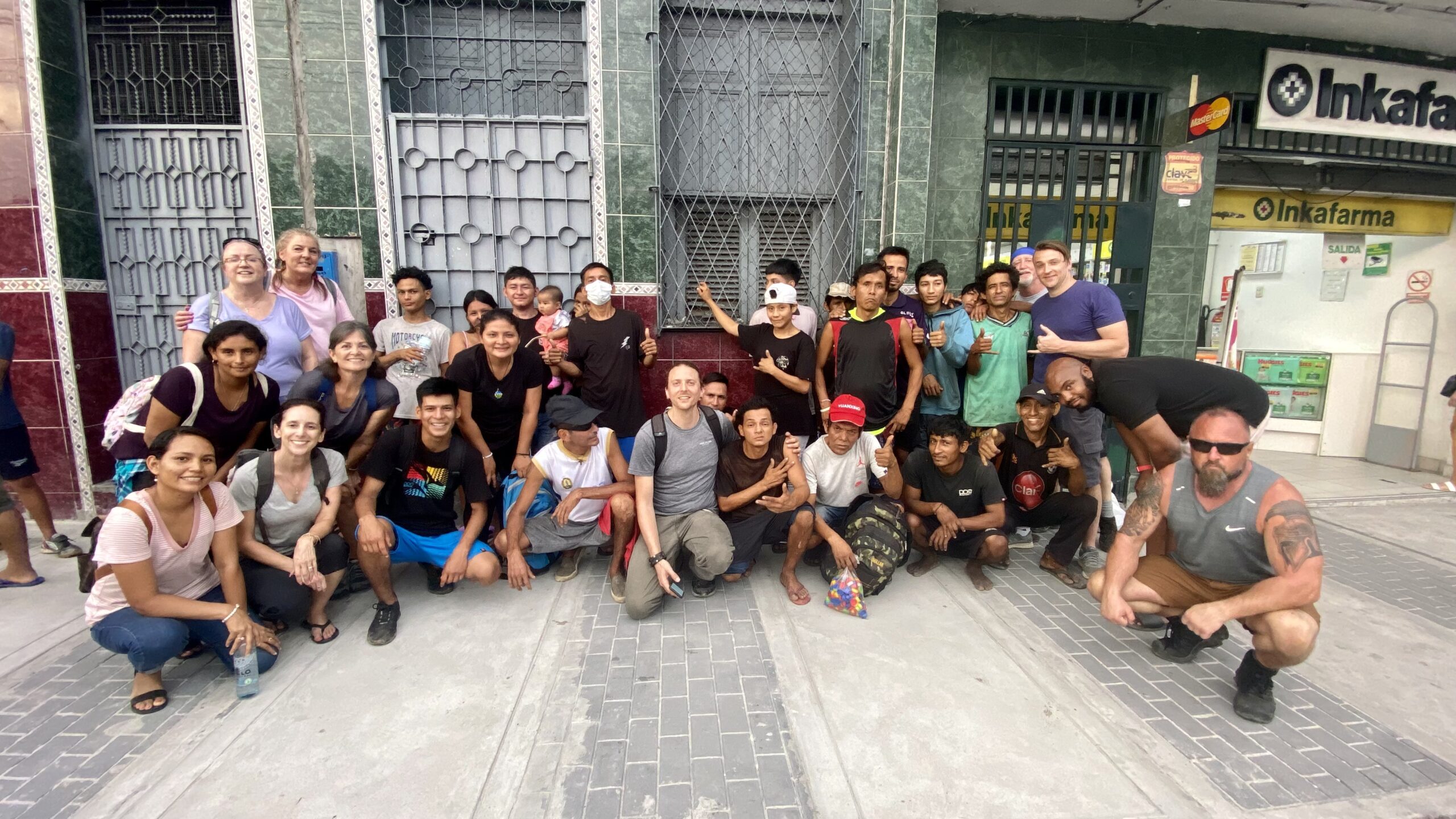
One of the things I love about going on mission trips with Overseas Missions is that we just don’t do what is expected of us.  Most short term mission trips seem to involve preaching at churches, building something for people, and/or feeding the poor.  All of these are good and have their place, but they’re sort of the norm.  Instead, while there are definitely some specific plans, there is also a lot of freedom with OM for us to be ourselves and just do what we feel led to do.  This means that in Peru one of the guys paid for over 1,700 ice cream cones over two days to give free ice cream to the people of Belen.  It was unplanned, but when he talked about it on social media, a bunch of his rich not-saved-yet friends decided they want to do that in the future when they go traveling overseas as well—which they do yearly.  Expanding the Kingdom can look like church meetings and salvations, but sometimes it looks like we don’t expect it to.  Which is why we took a bunch of drug addicts and homeless men and women to dinner.

When the plan was first shared with the locals, we invited a number of people who our local contact there would regularly minister to in a drug hole—a place where the locals would come and buy and use drugs, eventually passing out, having their stuff stolen, and all kinds of other unseemly acts while under the influence.  Normally the later the night got the more of this would occur.  After finishing up with a medical clinic, we began making the invitations and walking to the restaurant, a good twelve blocks from where we had done the clinic.  While at first there were about 15 people going with us, by the time we arrived that turned into about 30 people.  And keep in mind, this wasn’t the kind of thing that is easy to budget for—not because Overseas Missions lacks the ability to plan, but because God is into radical generosity and if Jesus didn’t turn away 5,000 men (not including women and children) after he preached to them, we’re not going to turn away a few extra people at a restaurant, even if we aren’t sure we have the money for it (and when all was said and done, a number of generous people saw about it on social media and paid for the whole meal).

One of the things that made this such a big deal is that some of these people have never eaten in a restaurant like this.  And keep in mind we aren’t talking some kind of 20-star American restaurant that charges $1000 a plate.  We’re talking about the kinds of places you and I might eat at with our family or friends without really even batting an eye at the price.  As a kid I used to think that Red Lobster and Olive Garden were these majorly upscale establishments and when I got older I realized they’re literally just normal restaurants.  Well, imagine visiting the Peruvian equivalent of a normal American restaurant, but this time you’re a homeless drug addict with no money and you’ve never eaten at one before.  For some of our guests, this was a big deal—and that was our goal.

You see, one of the things about carrying the labels that we give people, even some of the ones I’m using in this article—“homeless” and “drug addict”—is that in our minds it devalues people so we offer them less respect and mentally we remove value from them.  By inviting these men and women to be our guests, we are giving people honor who receive none.  Just being seen walking with us and the restaurant being unable to turn them away because they are with us gives them a huge boost in confidence and respect.  And that was a big part of our goal.  We wanted these men and women to understand that they, as sons and daughters of the King, have value and are worthy of dignity, honor, and respect.

So, as we sat down to the meal, we told them exactly that.  We ate in “family-style” dining where we have large plates of food we serve off of instead of individually-ordered meals, and we explained that we were doing this because each one of us, whether American or Peruvian, is a son or daughter of God.  That regardless of whether someone decides they want to know God more after this meal or if they simply want to enjoy a free meal that they can know that we are celebrating them and honoring them as God’s children.  And that as the one worldwide family of the One True God that we are eating the way families do.  Finally, we thanked them for honoring us with their presence by joining us, then we prayed over the food, and we all ate together.

One of the really cool things I got to personally observe is the way the culture of the Kingdom spreads little by little.  Jesus once explained to the disciples that they were to beware the leaven of the Pharisees and Herod because yeast is the sort of thing that once it gets into bread begins to spread throughout the entire loaf without someone even always recognizing it.  Well, our Father’s Kingdom is much the same, and where His Kingdom begins to be made manifest, it spreads.  One example of this I saw during the meal is that the man next to me had his face continually down to his plate and he was practically inhaling his food.  The guy was clearly quite hungry and was committed to eating, which was cool because we wanted them to be well-fed.  The man sitting across from me noticed his water glass was empty, so he took it upon himself to fill my neighbor’s water glass.  This sounds like such a little thing but we have to keep in mind that these men and women are used to a certain level of “every man for himself.”  When they are able to feel secure, knowing there is more than enough, they become free to serve one another freely, and this was simple evidence of that.

Sometimes we are looking for the big flashy miracles and the massive meetings where we can show our friends that thousands of people said a prayer to follow Jesus.  But big and flashy isn’t always what God is after.  Jesus sometimes went out of his way to offend people so those who were just waiting for flashy stuff to happen and weren’t serious would stop following him.  Spreading the Gospel of the Kingdom sometimes looks like big meetings and flashy miracles.  But sometimes it looks like taking a homeless addict to dinner—one who very well may be high as a kite while he’s eating.  But that’s okay.  Because Jesus didn’t come to those who have no need of Him, but to those who were desperately in need of His goodness, kindness, and love.  And we, the Body of Christ, are His hands and feet.


“When the Son of Man comes in his glory, and all the angels with him, he will sit on his glorious throne.  All the nations will be gathered before him, and he will separate the people one from another as a shepherd separates the sheep from the goats.  He will put the sheep on his right and the goats on his left.

“Then the King will say to those on his right, ‘Come, you who are blessed by my Father; take your inheritance, the kingdom prepared for you since the creation of the world.  For I was hungry and you gave me something to eat, I was thirsty and you gave me something to drink, I was a stranger and you invited me in, I needed clothes and you clothed me, I was sick and you looked after me, I was in prison and you came to visit me.’

“Then the righteous will answer him, ‘Lord, when did we see you hungry and feed you, or thirsty and give you something to drink? When did we see you a stranger and invite you in, or needing clothes and clothe you? 39 When did we see you sick or in prison and go to visit you?’

“The King will reply, ‘Truly I tell you, whatever you did for one of the least of these brothers and sisters of mine, you did for me.’” (Matthew 25:31-40)

Restoring Communion with the Animal Kingdom Part 2: Mindsets and Personhood

In Part 1 of this subject we discussed the responsibility that we carry toward the Animal Kingdom and how walking in a greater measure of communion with that Kingdom will cause us to need to bear more responsibility for them than we do currently. If you haven’t read it, you can catch up here: Restoring Communion with the Animal Kingdom Part 1: Responsibility and Cost. Today we are going to talk a bit about the personhood of animals and how we need to shift our mindsets to match with what is actually true, not what we have tended to believe previously. We will also be looking a bit more into what this will cost us to properly steward in the Kingdom of God.

I was giving our dog Seraphina a shower recently with flea shampoo and Sunshine was mentioning how she thinks I’m better with the dog (as far as how I treat her) than Sunshine is. Not that Sunshine is bad or abusive in any way—just that she thinks I tolerate and manage the dog’s behavior better. I replied that I think it’s probably because I recognize the dog has her own thoughts, will, personality, and emotions, and I don’t think we always take that into account enough as people. Sunshine said, “Well yeah, but she’s still just a dog.”

I replied, “Yeah, she’s a dog, but that’s exactly my point. What if part of our problem is that we relegate her to ‘just a dog’ status and ignore her will, emotions, and intellect?” It took a bit of convincing to get her to believe that dogs have a mind, will, and emotions (and I’m still not sure she’s entirely convinced), but it got me thinking.  Before going further, I’ll explain to you what I pointed out to my wife about animals having a mind, will, and emotions. Regarding Seraphina’s mind, we have the ability to train her to do things. She knows how to recognize certain commands and words, such as “outside”, “go home”, “crate”, “potty”, “Seraphina”, “puppy”, “food”, “hungry”, “no”, and more. Not only can she recognize these words, but she knows what they mean and in some cases what behavior is expected of her when we say those words to her. This requires intellect, or said another way, a mind.

As for Seraphina’s will, that is clearly evident in her behaviors, especially when we take into account the fact that she does have a mind and can understand some of what we tell her. When she is playing outside on our property and we tell her to “go home,” she knows she is supposed to, well, go home. The thing is, when she hears us tell her that, stops, looks at us, and then runs in the opposite direction she is enacting her will. A rebellious will mind you, but a will nonetheless.
Now for the emotions. When we first got Seraphina as a puppy, she had clearly been mistreated. It took a week before she started playing like a normal puppy would do and it wasn’t because she had some kind of developmental delay—it was because she was too afraid. I had to reach into her crate and pull her out of it and we would take turns holding her on our laps while she laid there shaking until she realized we weren’t going to hurt her. She wouldn’t take food from our hands for a while and we had to stop touching the food and move away before she would eat it. This animal was experiencing high levels of fear. Now, this is only possible if animals can experience emotions because fear is an emotion. Seraphina likewise experiences happiness, sadness, hope, disappointment, and other emotions as well, and if one observes her long enough, these various emotions become visibly evident. This is what I explained to my wife about our dog, but the same matters apply to all other animals.

In reality, the main difference we see between a dog and another animal, such as a beetle, is the level of intellect available. Theoretically all animals possess a mind, will, and emotions, but what allows them to display and/or experience a greater range of those things has everything to do with intellect or brainpower, or said another way, the size and complexity of their brain. Now, here’s where things get trippy. The human soul consists of a mind, will, and emotions, and as I have already proven, animals have the same. The level of intelligence they have, the intellect of their mind, will vary, but they still have one. The thing that’s fascinating is that when we realize that the human mind is not stored in the brain but the brain is the physical interface for the mind and the body, then it means that animals also have a soul that exists in a soul dimension similar to how we do (While some might like to use Greek and Hebrew to argue with me about this, I’m not talking about the spirit of the animal, I’m talking about their soul, and they aren’t the same thing. Argument over.).

Now, what would happen if we shifted our mindset and actually believe that animals have a mind, will, and emotions, have intellect, personality, and desires, and then treated them accordingly? I’m not even talking about if we could talk to each other, like I suggested in the prior installment, but what would it look like? How would we shift how we treat animals when we understand more about how they are made and what they experience? I believe if we truly understood this and changed our interactions with animals, we might see a difference in how they interact with us.

Now, I want us to come back around and take another look at this subject of cost. What price will we have to pay to communicate with animals and restore our relationship with the Animal Kingdom? Keep in mind as I discuss this that I’m not saying we should shy away from wanting things due to the price that may come as a result, but I do think it is important to think things through before we dive headlong forward without preparation. Luke 14:28-30 “Suppose one of you wants to build a tower. Won’t you first sit down and estimate the cost to see if you have enough money to complete it? For if you lay the foundation and are not able to finish it, everyone who sees it will ridicule you, saying, ‘This person began to build and wasn’t able to finish.’” If we want to steward the gift, we need to consider the price.

When we understand that animals have intellect and personality and have their own feelings and desires and then we are able to talk to them, what will that change for us? Let me throw out some ideas to consider—things that might ‘cost’ if we really could understand and communicate with animals like we are talking about. Going to the Veterinarian’s office might prove traumatic, as you will be exposed to the fear and pain of the animals present. An animal shelter would be even harder to go to, much less work at. Depending on how the animals are treated, the Pet Store, Zoo, and Circus might also become off-limits as well. If you’re a hunter, you might give up hunting simply because when you hear the dying cries of the animal you just shot, it will mean a lot more than it did before. Animals won’t just be ‘dumb beasts’ anymore to you – they will be your friends. If you’re a meat-cattle farmer, you’re probably going to need to find a new profession. Try telling all your animal- friends that you’re going to have to kill them once they get big enough. I mean, I’m sure they’ll understand, right?
This may sound entirely overboard to some and it may seem these things won’t matter much, but think again. Animals don’t just communicate using words like we do, and they certainly don’t use human-language when speaking to us. The communication is at its root soul-to-soul or spirit-to-spirit, whether it sounds like we hear them with our physical ears or not. If we shoot an animal with earplugs in, we may still hear their dying cries because it isn’t limited to the audible range, and as such simply going out of physical earshot is no guarantee either.

How do I know any of this? Have I had animals speak to me directly? Not that I recall. But I know others who have, and I have had enough experiences talking with plants, stars, angels and other non-physical beings that I have a few clues that indicate this is how it works. I have also experienced animals responding to my thoughts or words even if I didn’t hear theirs.

For one example of this, my wife and I were sitting in our car which we had parked on the side of a street. We were sitting in the car talking to each other with the sunroof closed but with the divider open so that we could see the glass above us. A black cat walked toward us, hopped up on the hood of the car, slowly walked up the front pane, over the top, and down the back, then hopped off and walked away a short distance. My wife and I both enjoyed this very much, as we got to observe the cat walk on the roof as well as the rest of the car. I even recall saying to her “I wish the cat would do that again – that was cool.” Within about 15 seconds the cat trotted over, hopped back up on the car hood, went quickly over the top and back down, and left. He/she looked back at us at one point and we both had the distinct feeling the cat was asking “There. Did that make you happy?” The cat was nice enough to humor our request, but it seemed like it found the request somewhat annoying. Clearly though, the cat heard our thought-request and complied when it was physically incapable of hearing us due to the windows being shut—and even if the windows had been open, the cat likely wouldn’t have understood my English. And yet, the cat did exactly what I wanted, meaning it understood what I wanted through nonverbal communication, proving my point.

I once had a dream that suggested there are many people out there who have had similar experiences communicating with animals, and that some do it regularly but have simply been unwilling to talk about it, especially in the Church, for fear of negative labels and derision from others. I firmly believe that people often don’t want to take risks and share things because they feel unsafe—and often times other people make it unsafe to share. My hope is that by opening this subject up we can help empower people to start conversations about this topic and walk forward into greater communion with the Animal Kingdoms together. Let’s get started!

Restoring Communion with the Animal Kingdom Part 1: Responsibility and Cost

There are many people out there who would like talk to animals. Or rather, I should say that want to hold conversations with animals (talking to them isn’t hard, but understanding when they talk back is another matter entirely). In addition to just talking to animals, there is a desire for the separation between Man and the Animal Kingdoms to be removed, that the veil between the two would be torn once and for all.

The Bible says that there will be a day when the lion will lie down with the lamb, and a little child will lead them. This is typically relegated to a far-off future post-return of Jesus in the Second Coming. But the veil was torn over 2000 years ago and there is no longer a separation, so we can have connectedness and peace now. And while one could say that the temple veil represented separation between God and man only, I suggest that is not so. Jesus died to set us free from every curse and bondage and place that was less-than God’s intent, so it would stand that all separation of every kind brought in through the Fall of Man was dealt with, not just that of God and man.

The fear of Man was placed upon animals at a time when (I theorize) that there was a dietary deficiency as a result of the flood. It is possible that it was the atmospheric change that scientists have theorized that caused this change, or it may simply have been that so much of the earth was covered with water that many plants simply died after that length of time and some of those plants became extinct. It is possible that any number of other things transpired to cause this change—we will never know outside of divine revelation.

What we do know is that as is recorded in Genesis, after the Flood the rules changed. Animal began to eat animal (suggesting that all animals had been herbivores prior), and Man started to eat animals as well. I imagine it was due to survival needs and in order to protect creation that God placed fear of Man into animals. And why not? After all, He loves animals too. It would be uncharacteristic of God to tell mankind to make animals a target and then in turn give animals no internal warning system whatsoever to let them know Man is now a dangerous species. Due to this warning system, however, animals run away from people unless they as a species have been tamed over a long period of time.

If walking in a forest, deer usually run away when they see a person. If a squirrel or bird is hanging out at a bird-feeder, they will typically run or fly away when a human approaches, even if the person approaches slowly and with no negative feelings directed toward that animal. It’s almost as if something about our very presence tells the animals to “get away.” I believe it is time for this fear to be removed not just conceptually, but in practice.

Before we take another step to start asking God to remove that fear, I think we need to look at some things honestly. For starters, why do we want this ability with animals? If it’s because we “want to,” because we love animals, or because we have some other positive, non-threatening reason, then it stands to reason that pursuing this ability is worthwhile. After all, Jesus purchased it at a very high price, so why should we not live in it? However, this ability doesn’t come free of charge–anything that God gives us comes with a measure of responsibility. An example of this is our diet—do we eat meat? And are there hunters among us?

If the second of the above answers was “yes,” we are at the greatest risk for misusing and abusing this capacity. If you think about it, are we really going to lure animals into a sense of false security only to then trap or kill them and eat them? This is probably the very reason why God put fear there in the first place. If we decide we want to live at peace with the Animal Kingdom then we actually have to live at peace with them. I’m not saying one has to become a 100% raw-food vegan, but in reality if we want to live in a manner that respects the lives of animals then we must treat them differently than we have collectively in the past.

Animals are a large part of our economy, not just the food chain. Almost every restaurant in the U.S. alone serves meat in 80% or more of its food dishes, and often the percentage is much higher than that. There are some farmers who raise nothing but meat-animals, and there are many jobs that do nothing but handle dead animal-flesh. Some examples: taxidermist, butcher, meat-attendant-at-grocery-store, meat packing company employee, food-processor-of-dried-meat-products-employee, professional game hunter, restaurant cook/chef, rancher/ranch hand, trucker-who-ships-meat-and-livestock. If we stopped eating meat, we would actually remove thousands and thousands of jobs from the economy. While those people would eventually find other jobs or work in other similar job-areas that don’t involve meat, the point is that carnivorous behavior is actually quite ingrained into our culture. To take a step away from that and choose to be vegetarian actually limits food choices greatly, which is a consideration we have to look at. Even if we all decided to go vegetarian (which isn’t likely), there would have to be some kind of scalability to the process to phase out of old ways and into new ones. In reality, if we start collectively changing our habits now, it will likely take a generation (about 20+ years) before we see a significant difference.

A few years ago I was preaching at a gathering in Washington State and as per the custom of that group, they gathered together prior to the meeting for food and fellowship potluck-style. I didn’t tell anyone at the time that I was vegetarian (I’m not currently but was then), and I didn’t believe in imposing my dietary choices on other people for a single evening. But as a result there was actually only one food item there that I could eat—macaroni and cheese. And don’t get me wrong—I like mac and cheese. But with a large gathering and literally only one food item that wasn’t meat, it kind of makes the point I’m getting at. And I’m not just talking about foods that have touched meat or have pieces of meat in them. I mean that every one of the non-mac-and-cheese items offered were all different forms of cooked meat—thus there was no “eating around it.” And please don’t hear this as a complaint—I chose not to make my food preferences known, and I enjoyed both my meal and the company I kept while eating it. I am using this example to point out that if we want to live at peace with the Animal Kingdom, we will need to make some mental shifts in our lives, resulting in some physical shifts and possibly dietary changes as well.

Let’s revisit the responsibility issue of a greater dominion over the Animal Kingdom and ability to communicate with them better. Let me explain what I mean—for every area of supernatural connection that we gain, whether it be with Animals, the Nature Kingdom, Stellar Spirits, or some other group, we open ourselves up to a greater measure of responsibility. For example, if I can talk to animals then when they approach me with problems, it stands to reason that I will need to at least attempt to do something about it. Additionally, many animals habitats worldwide have been drastically altered and managed by humans, and as such they are going to need our assistance for a number of the problems they run into because we’re often the ones that caused them to begin with.

Being Dr. Dolittle could have its high points, and I’m sure it does, but it also comes with its own price. What if we were busy trying to order our pets around and it told us it didn’t like it when we talked to it like that? How would we handle a rebuke from an animal? I’d be shocked if Balaam was expecting the response he got from his donkey when he was busy beating it. And to be honest, Balaam was pretty blessed that he got a donkey who wasn’t inclined to fits of rage, as kicks from donkey hindquarters can be deadly when aimed properly. And what are we going to do when the deer take over our yard and eat our garden to shreds during hunting season because they’re running from the hunters and know they’re safe at our place?
Or what if our neighbor’s cat comes for a visit and tells us what he sees the father doing to the child late at night when mother is sleeping and he thinks no one is watching? How do we handle that? Precious few authorities on the planet would believe us if we said “the cat told me the father is molesting his child”, and it certainly won’t stand up in court of law. I get that got real dark real fast, but these are the kinds of problems we will actually run into. Are we prepared for them?

I’m not saying we should shy away from wanting things due to the price that may come as a result, but I do think it is important to think things through before we dive headlong forward without preparation. Luke 14:28-30 “Suppose one of you wants to build a tower. Won’t you first sit down and estimate the cost to see if you have enough money to complete it? For if you lay the foundation and are not able to finish it, everyone who sees it will ridicule you, saying, ‘This person began to build and wasn’t able to finish.’” If we want to discover how to restore communion with the Animal Kingdom, I believe it is good to do so, as it is part of what Jesus purchased for us. I believe that in the same way God is restoring the revelation of life and immortality to us, God is also restoring our ability to communicate with the Animal Kingdom—but I think we need to also consider what it will cost us. It is my hope that by discussing this, we will be able to reason through some of the things we need to learn and understand as God releases this to us so that we can properly apprehend, live in, and steward the gift.
We will be covering more about this subject in Part 2, dealing with Mindsets and Personhood. Come join us next week!


Privacy Preference Center